Pallet delivery & warehouse multi-drop
Distribution that runs on your schedule
Two kinds of customer use us. Pallet networks and logistics companies contract us as their final mile — collecting from the depot and delivering across South East London, Kent and Essex, to business and residential addresses alike. Businesses use us to collect stock from a warehouse and get it where it is needed, run as a route rather than charged as a parcel.
What we run
Pallet delivery, warehouse multi-drop and dedicated vans
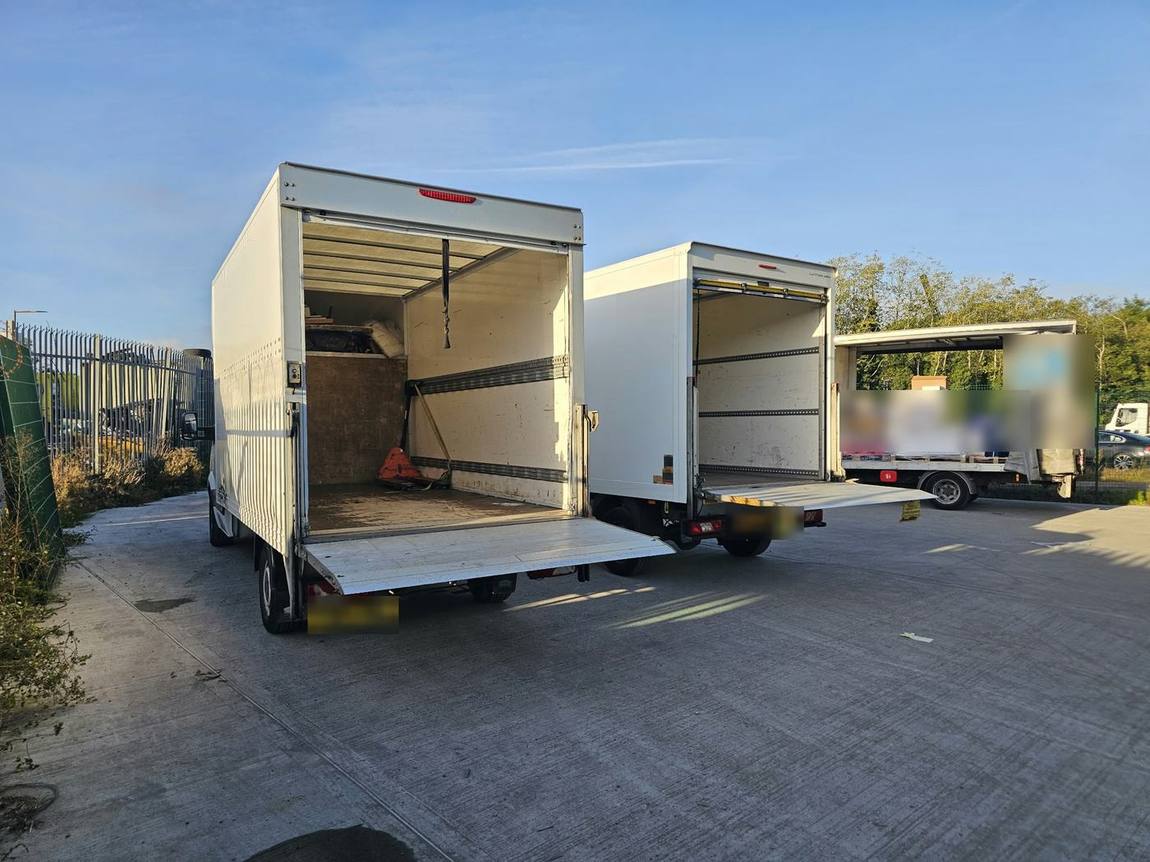
Four shapes of work, and they run differently because they use the vehicle differently. A pallet run is weight, tail-lift access and whether the address is a business or a house. A warehouse multi-drop is drop count and dwell time. A furniture delivery is two people and a staircase. A driver short is a vehicle and a person for a fixed number of days.
Final-mile pallet delivery for pallet network partners.
We work with pallet network partners, collecting pallets from their depot and distributing them locally — to businesses and to residential addresses. Full, half, quarter and light pallets, delivered kerbside by tail lift and pump truck where there is no forklift or no loading bay, which is most houses and most high-street units. Our vans carry the tail lift and the pump truck, so a pallet that cannot be taken off at the far end is a problem we have already solved rather than brought back to your depot.
Stock picked up from a warehouse and delivered where it is needed.
We collect stock from a warehouse, a supplier or a fulfilment site and run it out to where the business actually needs it — shops, branches, trade counters, sites and customers. Daily restocking, weekly replenishment runs, or an irregular sequence tied to demand. One vehicle, one driver, a planned sequence of stops loaded in delivery order, so the first drop is at the door and the business is not waiting on stock it has already paid for.
A crew of two and a van, delivering to the room of choice.
Furniture, appliances, mattresses and anything one person should not be carrying up a staircase. Two-man delivery means the item goes to the room of choice rather than to the doorstep, assembly happens where it is needed, the packaging leaves with us, and a delivery that cannot be completed comes back rather than being left on a path. For furniture retailers this is the difference between a delivery and a complaint.
Our vehicle and our driver, running your schedule and your paperwork.
When the work is yours and the capacity is not — a driver off sick, a seasonal peak, a round your own fleet cannot absorb — we supply the van and the driver to run your routes. Same driver and same vehicle on recurring work wherever we can, because a round learned is a round run faster. Your routing, your customers, your proof-of-delivery format; our vehicle, our insurance, our driver. By the day, the week, or on a standing arrangement.
For pallet networks and logistics companies
Final mile pallet delivery in South East London and Kent
A pallet network runs hub and spoke: goods come into a member depot, trunk overnight to the hub, sort by destination and trunk back out to the delivering depot. The part that decides whether the customer is happy is the last one — the local run from that depot to the door. That is the part we are contracted to do.
We are already delivering pallets on behalf of network partners across our area, to their customers, both business and residential. For a depot that is short of vehicles, short of drivers, or holding more volume in a postcode than its own fleet can clear in a day, we are capacity that already knows the ground.
- Depot collection — we collect from your depot to your cut-off, not ours.
- Business and residential deliveries — kerbside pallet delivery by tail lift and pump truck, to a firm level surface, with the access check done before the vehicle is committed.
- Proof of delivery at every drop, in the format your system reads — signature, photograph, timestamp, or your own consignment reference.
- Failed deliveries handled properly — reported the same day with the reason, held or returned to your instruction, not left on a path.
- Overflow and peak capacity — extra vehicles for the days your own fleet cannot absorb the volume.
- One point of contact, and the same drivers on your work rather than whoever is free.
For businesses
Stock collected from the warehouse, delivered where it is needed
Most businesses do not have a distribution problem so much as a gap between where the stock is and where it has to be. It sits at a warehouse, a supplier, a fulfilment site or a port, and getting it out to shops, branches, sites, trade counters and customers is somebody's unsolved Monday.
We pick stock up and run it out — on a fixed weekly pattern, daily, or whenever demand says so. Palletised, in cartons, in totes, in cages, or loose and awkward. The point is simple: the business gets its stock where it needs it, without holding vehicles and drivers it only needs three days a week.
- Collection from warehouses, suppliers, fulfilment centres and ports
- Store replenishment and branch replenishment runs, planned around opening hours
- Multi-site and multi-drop delivery across London, Kent and Essex
- Inter-site transfers and stock moves between your own locations
- Deliveries to your customers, business and residential
- Returns and failed deliveries collected on the same round
How it is priced
What actually sets the price of a route
There is no online calculator on this page, and that is deliberate. A route is not a parcel: the same five drops can be a half-day or a full day depending on where they sit, how long each site holds the driver, and whether anything has to come off a tail lift. A form that guessed at that would give you a number we would then have to change — which is the thing we are trying to put an end to, not repeat.
So we price the route once you tell us its shape. These are the six things that move the number, and the enquiry form below asks for exactly them.
Mileage, yes — but more importantly how the drops sit relative to each other. Six along one corridor and six scattered across two counties are not the same day.
The cost of the driver and the vehicle is spread across every stop, so the cost per drop falls as the round fills. That is why a planned route beats booking each delivery separately.
The hidden cost in distribution. Two sites that hold the driver forty minutes each cost more than six that take ten. Goods-in doors, sign-ins and queues all count.
Small van, Transit or Luton — and whether the receiving end has a forklift, a bay, or neither. No forklift means tail-lift delivery to the kerb, which takes longer and needs firm, level ground.
A one-off run is priced ad hoc. A recurring route is quoted after a trial run, which normally works out lower than booking each round individually.
Weight and shape, not pallet spaces. A full pallet at 1,200 kg and a quarter pallet at 250 kg are different deliveries to the same address.
Tell us those and you get a real figure with the assumptions written down, rather than an estimate that moves. Recurring work — a standing network run, a weekly replenishment round — is rated once and then stays rated, so neither side is renegotiating a route every month.
Contact us to discuss a partnershipRoute planning
Routes planned around your delivery pattern, not ours
We plan distribution routes around your actual delivery pattern — daily restocking across retail sites, weekly runs to multiple business locations, or an irregular schedule tied to demand. For businesses distributing to their own sites, whether branches, warehouses or retail units, we run dedicated routes on a fixed schedule, with the same driver and the same vehicle wherever we can.
That consistency is not a nicety. A driver who knows which door at the back of the parade is yours, which site wants the delivery before ten, and which one has a barrier that needs a code, completes a round faster than a stranger with the same list — and a faster round is a cheaper round.
What every route includes
- Scheduled multi-site and multi-drop distribution
- Route planning for efficiency and consistency
- Proof of delivery confirmation at every stop
- Dedicated drivers for recurring routes
- Tracking across the full route
- Daily, weekly or demand-based scheduling
What proof of delivery means here
Confirmation at every stop, in the format your system actually reads: a signature, a photograph of the goods where they were left, a timestamp, or a reference tied back to your own order number. Tell us what you need to reconcile at your end and we will match it, rather than handing you ours and asking you to re-key it.
Pallet distribution
Pallet sizes, weights and what actually fits
These are the published UK standards every pallet network works to. Knowing which one you are sending is most of the quote — the footprint decides how many go on the vehicle, and the weight decides whether the site can take it off.
| Pallet | Footprint | Max weight | Max height |
|---|---|---|---|
| Full UK pallet | 1200 × 1000 mm | Up to 1,200 kg | Up to 2.2 m |
| Euro pallet | 1200 × 800 mm | Up to 1,200 kg | Up to 2.2 m |
| Light pallet | 1200 × 1000 mm | Up to 750 kg | Up to 2.2 m |
| Half pallet | Full footprint, half height | Up to 500 kg | Up to 1.2 m |
| Quarter pallet | Quarter footprint | Up to 250 kg | Up to 0.8 m |
Industry standard dimensions, published by UK pallet networks and packaging suppliers. Not a Hilogisticz specification.
The three questions that decide a pallet route
- Can the delivery point unload? A forklift or a loading bay at the far end changes the vehicle, the time on site and the price. No forklift means tail-lift delivery to the kerb and a pump truck, and the ground has to be firm and level for that to work.
- What does each pallet weigh? A full pallet at 1,200 kg and a quarter pallet at 250 kg are not the same delivery, even to the same address.
- How long does each site take? Dwell time is the hidden cost in pallet distribution. Two sites that each hold the driver forty minutes will cost more than six that take ten.
Worth asking any supplier
How to check a distribution supplier is legitimate
Distribution is one of the easier things to be sold badly, because the person selling it is rarely the person driving it. Four questions separate an operator from a broker, and you are welcome to put all four to us.
For UK work, a goods vehicle at or under 3.5 tonnes maximum authorised mass does not need a goods vehicle operator's licence; above 3.5 tonnes it does. Since 21 May 2022, carrying goods for hire or reward internationally needs above 2.5 tonnes. Ask which bracket the vehicle on your route sits in.
Ask for the figure and ask what it covers per year rather than per van. Ours is £50,000 on every job, and it is the same figure on a removal and on a pallet run.
Ask whether the driver is theirs or subcontracted, and what happens on the day the regular one is off. We subcontract at peak and we say so when we do — the coordinator and the accountability stay with us either way.
Ask to see the format before you sign, not after the first disputed delivery. If a supplier cannot describe how a missing drop gets proved either way, that is the answer.
Who we work with
Networks, and the businesses that run on routes
Final-mile pallet delivery off your depot to business and residential addresses, plus overflow capacity on the days your own fleet cannot clear the postcode.
Subcontract capacity on routes you have won but cannot staff — vehicles, drivers and proof of delivery in your format.
Two-man delivery to the room of choice, assembly, packaging removal, failed-delivery recovery and returns collection on the same round.
Pallet and tote multi-drop to trade counters, sites and branches, on a fixed weekly pattern.
Daily or weekly restocking across shops, bars and kitchens, loaded in delivery order and timed around opening.
Materials and equipment to several sites on one run, with the drops sequenced around site access hours.
Bulky last-mile delivery that a parcel carrier will not take, and the returns that come back with it.
Scheduled deliveries to tenanted and void properties, with proof of delivery against the property reference.
Warehouse to wherever it is needed
Getting stock out of the warehouse and into the business
Stock sitting in a warehouse earns nothing. We collect it — from your own warehouse, your supplier's, a fulfilment centre or a port — and deliver it where the business actually needs it: the shop floor, the branch, the site, the trade counter, or straight on to the customer. Palletised, in cartons, in totes, in cages, or loose and awkward.
That can be a standing weekly run, a daily replenishment round, or a collection the day something lands and has to move. The job is the same either way — make sure the stock is where it has to be, when it has to be there, so nobody is selling off an empty shelf or paying storage on goods that should already have gone out.
Pallet delivery in practice
Tail lift, pump truck, kerbside — and the pallet actually comes off
Most pallet deliveries do not fail in transit. They fail at the far end, because the address turns out to have no forklift, no loading bay and nowhere level to set a pallet down — which describes most houses and a good share of high-street units. Our vans carry a tail lift and a pump truck for exactly that reason, and the access question gets asked before the vehicle is committed rather than discovered on the doorstep.
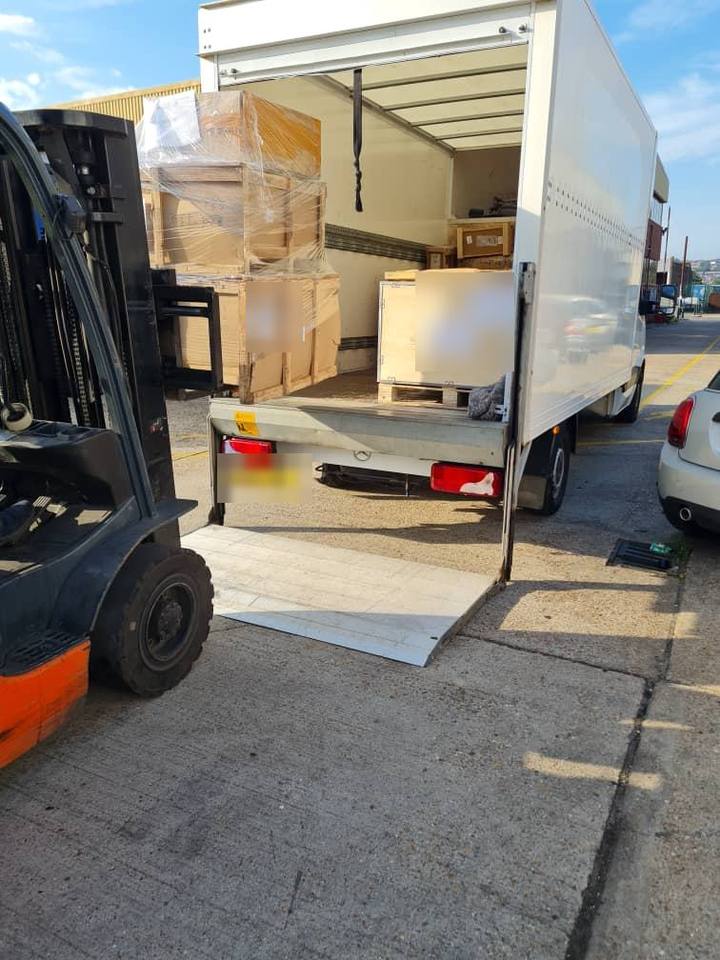
Loaded onto the lift, strapped to the rails
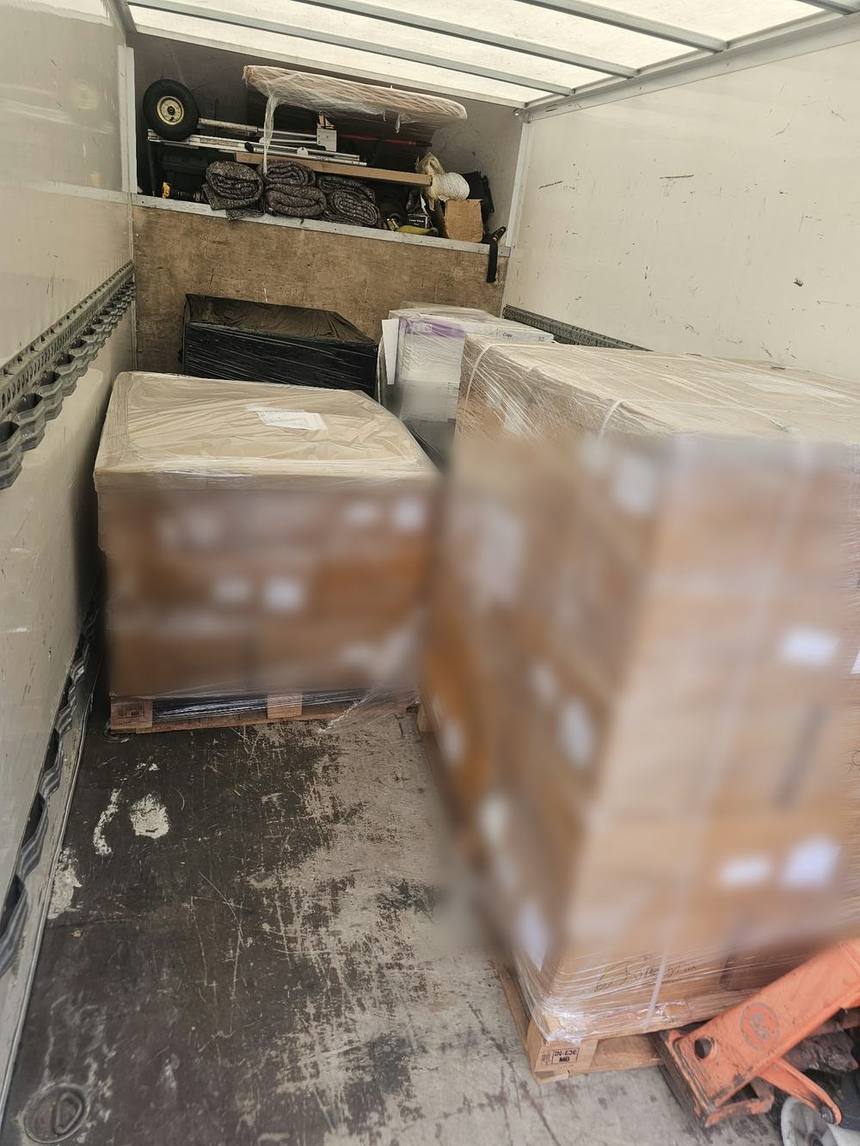
A tail lift is what turns a van into a pallet vehicle. Without one, a pallet can only be delivered somewhere with a forklift or a dock, which rules out most high-street shops, most small trade counters and nearly every site with a time-limited bay outside.
Inside, the load is strapped to the van's own rails rather than stacked loose and hoped over. On a multi-drop round that matters more than on a single delivery, because the load is opened, cut into and re-secured at every stop — and the last drop deserves the same condition as the first.
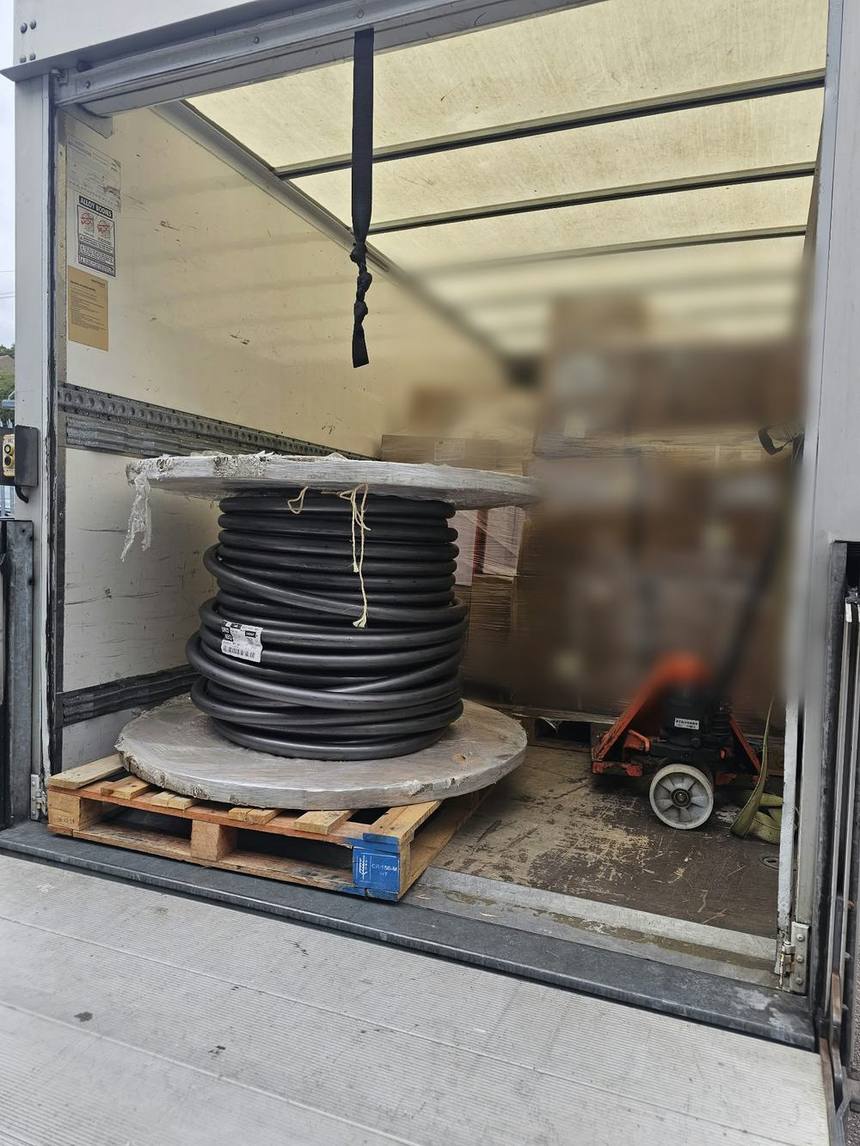
Not everything on a pallet is a box
Cable drums, crated machinery, rolls, frames and anything else heavy and awkward on a pallet move the same way: lifted on, strapped to the rails, and taken off with whatever the receiving site actually has. The pump truck travels with the load for exactly that reason.
If you are sending something that is not a neat 1200 × 1000 cube, tell us what it is and what it weighs rather than how many pallet spaces it takes up. That is the number that decides the vehicle.
Our own work
A route we run week in, week out
[STILL NEEDED: one named route to go with these photographs — the client type, the area, drops per run, vehicle, how often it runs, and one thing that made it awkward. §66 does not allow a case study to be written before the job exists, and with the photographs in place this is the last empty slot on the page.]
Networks and businesses
Contact us to discuss your subcontracting requirement
Tell us the shape of the work and how we would fit into what you already run — whether that is final-mile pallet delivery off your depot, a warehouse collection and multi-drop round, or vehicles and drivers on your own routes. Not a generic contact box: these are the questions that actually decide whether we are the right partner, and the last one is usually the one we end up fixing.
About the business
What the work is
Where, when and how often
The bit that matters most
We reply with questions about the route rather than a generic quote. If it is urgent, 07379 004538 reaches someone directly.
Questions people actually ask
Do you work as a pallet delivery subcontractor for pallet networks?
What is final-mile pallet delivery?
Do you deliver pallets to residential addresses?
What is kerbside pallet delivery?
Do your vehicles have a tail lift and a pump truck?
What pallet sizes do you carry?
Can you collect stock from our warehouse and deliver it out?
What is warehouse multi-drop delivery?
Can you supply a van and driver for our own routes?
What does two-man delivery include?
Do you provide proof of delivery?
What happens when a delivery fails?
Do we need an operator's licence to use you?
Which areas do you cover?
What sort of businesses do you work with?
How do we start?
Not a pallet route? We still want to hear about it.
Office removals, event logistics and one-off furniture collection all run through the same business team.
